

Invest in Bangladesh from Brazil
Md. Joynal Abdin
Founder & Chief Executive Officer, Trade & Investment Bangladesh (T&IB)
Editor, T&IB Business Directory; Executive Director, Online Training Academy (OTA)
Secretary General, Brazil Bangladesh Chamber of Commerce & Industry (BBCCI)
Bangladesh is at an investable inflection point: a large, export-led manufacturing economy that is simultaneously tightening macro-stability policies (inflation, reserves, exchange-rate reforms), modernizing investment facilitation (One Stop Service), and expanding zone-based industrial infrastructure (EPZ/EZ models). Recent official and multilateral indicators show (i) subdued but recovering growth, (ii) elevated inflation that is easing but still high, (iii) improving external buffers, and (iv) sustained export competitiveness anchored by apparel while the government continues to use tax incentives and PPP frameworks to crowd in private and foreign capital. [1]
For Brazilian investors, the economic logic is strongest where Brazil’s global strengths (agro-commodities, industrial inputs, energy, logistics, and consumer-market know-how) intersect with Bangladesh’s core advantages: scale manufacturing, a highly export-oriented private sector, and policy-backed “industrial clustering” in economic zones. Bangladesh’s trade relationship with Brazil is already meaningful and widening, including Bangladesh’s rising exports to Brazil and Brazil’s position as a major supplier to Bangladesh’s import basket creating a natural corridor for two-way investment, not just trade. [2]
The fastest path to bankable returns typically involves one of three playbooks: (1) export-platform manufacturing inside EPZ/EZ frameworks (tax incentives + “ready” utilities + simplified customs), (2) Bangladesh market-entry platforms (distribution, light assembly, after-sales) for consumer/health/industrial products, and (3) infrastructure and energy via regulated PPP processes and Viability Gap Financing (VGF), where structured risk-sharing can unlock project cashflows. [3]
Introduction
“Invest in Bangladesh from Brazil” is not a slogan; it is a strategic proposition: deploy Brazilian capital, technology, and operating discipline into a South Asian production-and-consumption hub that remains deeply integrated with global supply chains, particularly in textiles and increasingly in pharmaceuticals, plastics, light engineering, and renewables. Bangladesh’s investment authority explicitly positions the country as a gateway bridging South and Southeast Asian demand, and it frames its scale of labor and consumer growth as a central pull-factor for foreign investors. [4]
Timing also matters. Bangladesh is scheduled to graduate from Least Developed Country (LDC) status on 24 November 2026, an institutional milestone that can reshape trade preferences and policy priorities. That transition tends to push governments to “lock in” competitiveness through infrastructure, reforms, and investment attraction while prompting first movers to pursue early positioning in zones, suppliers, and export diversification plays. [5]
Market fundamentals
Bangladesh’s macro picture is best presented as a stability-and-recovery narrative rather than a straight-line growth story. The International Monetary Fund projects GDP growth rebounding to 4.7% in FY2026 and FY2027, after slowing to 3.7% in FY2025, while inflation is projected to remain elevated at 8.9% (annual average) in FY2026 before easing toward ~6% in FY2027. [6]
Inflation remains a visible investor risk, but current official prints show it below earlier peaks: Bangladesh’s national point-to-point inflation was 8.58% in January 2026 (food 8.29%, non-food 8.81%) per the national statistics office. [7]
From an external-sector standpoint, the IMF’s FY2025–27 indicator set points to rebuilding buffers and a manageable (but persistent) trade deficit: FY2025 trade balance -5.6% of GDP, current account around 0.0% of GDP, and gross international reserves $26.8B (FY2025 actual) rising in projections thereafter. [6]
Currency and FX policy are central to investment confidence. Bangladesh’s exchange-rate framework has been under reform pressure tied to IMF-supported stabilization, with policy moves emphasizing greater flexibility (including a “crawling peg” reform context in 2025) and institutional changes aimed at strengthening revenue and macro management. [8] For business planning, an official export statistics compilation reports an average exchange rate of 120.810 taka per US dollar in FY2024–25 (average), which can be used as a practical planning parameter (while still requiring hedging and sensitivity analysis). [9]
Exports remain the foundational demand engine. Bangladesh’s total export earnings from goods and services reached $55,191.24 million in FY2024–25, up from $51,114.15 million in FY2023–24; goods exports alone were $48,283.93 million in FY2024–25. [10] Within goods exports, apparel dominates: the garment industry association reports total RMG exports of $39.346B in FY2024–25, up 8.84% year-on-year. [11] (Using FY2025 nominal GDP in taka from the IMF and the FY2024–25 average exchange rate from export statistics, FY2025 GDP is roughly $456B as an estimate; this conversion is an assumption-based estimate and should be stress-tested.) [12]
Foreign direct investment (FDI) is meaningful but not yet “high for its scale,” which is exactly why targeted sector-and-zone strategies matter. In IMF terms, net FDI is around 0.4% of GDP in FY2025 (actual) in its balance-of-payments framing. [6] Bangladesh Bank-derived figures reported in local business press indicate net FDI inflows of roughly $1.41B in FY2023–24 and $1.71B in FY2024–25, illustrating both scale and volatility (definitions and measurement bases should be reconciled in investor due diligence). [13]
Policy, governance, and business environment
Bangladesh’s operating environment needs to be read with two lenses: (1) near-term political/administrative volatility, and (2) medium-term institution-building and reform conditionality. The IMF explicitly notes recent economic slowdown, elevated inflation, governance and financial-sector vulnerabilities, and the importance of decisive reforms to stabilize and unlock growth. [6] Reuters reporting around Bangladesh’s 2026 election period similarly frames corruption and inflation as major public issues and highlights the country’s political transition since 2024 factors that investors should treat as material for risk assessment and contract structuring. [14]
Governance risk is measurable. Transparency International’s 2025 Corruption Perceptions Index places Bangladesh at score 24 and rank 150 of 182 (methodology: perceptions-based composite index). [15] This does not automatically negate investment viability, but it increases the value of: (i) zone-based “single-window” facilitation, (ii) robust compliance programs, and (iii) transaction structures with clear audit trails.
On business facilitation, Bangladesh’s investment architecture is anchored by the national investment promotion agency, whose legal mandate is set in statute and whose “One Stop Service” framework is also established by law designed to ensure time-bound delivery of licenses, approvals, and permits via designated authorities. [16] A chamber document describing the OSS initiative notes that the platform targets 154 business-related services across 40+ agencies, indicating the government’s direction toward administrative consolidation (implementation quality varies by service). [17]
Ease-of-doing-business measurement has shifted globally (with the World Bank’s former Doing Business project discontinued). Practically, investors can use logistics- and port-performance metrics as “operational proxies.” Bangladesh’s logistics performance in the World Bank’s Logistics Performance Index 2023 is reported in business press as ranking 88th with score 2.6, and port-performance benchmarking places its primary port city in a low position regionally (see infrastructure section). [18] These indicators reinforce that Bangladesh is best approached via location intelligence (pick the right zone/corridor), process engineering (customs/logistics planning), and institutional partnering (BIDA/BEPZA/BEZA interfaces).

Infrastructure and talent platform
Ports and logistics are the immediate constraint and opportunity in Bangladesh’s investment story. The country’s principal container gateway in Chattogram[19] handled 3.26 million TEUs in 2024, up 6.8% from 2023 (reported based on port authority data), signaling rising throughput but also underscoring why logistics capacity, depots, and digital trade facilitation are investable complements to manufacturing. [20] In the World Bank’s Container Port Performance Index 2023, Chattogram is shown with an overall ranking of 339 in its regional table an objective signal that efficiency gains (terminal ops, inland connectivity, digitization) remain a competitive lever. [21]
Energy reliability and cost structure remain critical for industrial investment. The IMF highlights the importance of strengthening the financial viability of energy state-owned enterprises as part of macro-financial stability an indirect but important signal about the policy focus on energy-sector governance. [6] On the transition side, Bangladesh’s renewable-energy authority reports 1,694.5 MW of renewable installed capacity as of 1 February 2026 (including large contributions from solar), supporting investability in distributed solar, industrial energy efficiency, and “green compliance” upgrades for export-facing factories. [22]
Digital infrastructure is expanding, though statistics can differ by definition. One official-referenced report indicates Bangladesh’s internet usage base has reached very large scale (news reporting attributes subscriber numbers to the telecom regulator), and the broader policy narrative frames “digital evolution” as a national advantage. [23] For investors, the practical implication is that back-office services, e-commerce enablement, and IT-enabled exports can scale provided FX settlement, payments integration, and data compliance are mapped early.
Labor and skills are Bangladesh’s enduring comparative advantage, but investors should treat labor economics as sector- and location-specific. Bangladesh’s export model employs millions in garments alone (news reporting commonly cites ~4 million workers), which is central to its ability to deliver large-volume manufacturing under tight lead times. [24] To convert this workforce scale into investable productivity, foreign entrants usually succeed when they combine: (i) lean manufacturing systems, (ii) formal training pipelines, (iii) compliance-by-design (labor, safety, environmental), and (iv) local management depth.
Investor rulebook
Bangladesh’s foreign investment framework combines statutory protections, company law, tax administration, and foreign exchange rules, with practical execution often channeled through investment authorities and economic-zone structures.
Foreign investment protections and legal basis. Bangladesh’s core statute for foreign private investment protection is the Foreign Private Investment (Promotion and Protection) Act, 1980, which sets the legal baseline for promotion and protection of foreign private investment. [25] Corporate formation is governed by the Companies Act, 1994, and incorporation/filings interface with the national registrar. [26]
Investment facilitation and “one-stop” implementation: The Bangladesh Investment Development Authority Act, 2016 establishes the investment authority and its mandate, and the One Stop Service Act, 2018 creates a legal framework for time-bound delivery of permissions and services through designated OSS entities. [16]
Zone-based industrialization and incentives: Bangladesh’s incentives are heavily “place-based,” meaning EPZ/EZ location often determines both tax benefits and customs facilitation.
- In EPZ structures, incentives commonly include tax holidays and duty exemptions; BEPZA’s published materials show tax-holiday structures that vary by zone (e.g., 7-year schedules for certain EPZs and 5-year schedules for others, with declining exemption rates over time). [27]
- For BEPZA’s economic zone model, published brochures specify a 10-year tax holiday with a declining exemption schedule (100% in early years tapering to 20% by year 10) and list duty-free import facilities and other benefits. [28]
- For BEZA-style economic zones more broadly, a consolidated incentives package document (compiled within the foreign investors’ chamber ecosystem and citing specific SRO references) details graduated corporate tax exemptions for unit investors, as well as developer incentives (stamp duty, land development tax, and other fiscal reliefs) and duty/VAT facilities. [29]
PPP and structured infrastructure investment: Bangladesh uses a formal PPP statute and financing tools to de-risk projects:
- The Bangladesh Public–Private Partnership Act, 2015 (official English translation) frames PPP as a legal mechanism to involve private sector participation and attract local/foreign investment in infrastructure and public services. [30]
- The Rules for Viability Gap Financing (VGF) for PPP Projects, 2018 define VGF as a direct subsidy via capital grant and/or annuity, specify that VGF is used for financially non-viable but socio-economically beneficial PPP projects, and set proportionality/eligibility rules explicitly including caps where total VGF should not exceed 40% of total estimated capital/project cost (as stated in the rules). [31]
- For unsolicited PPP proposals, guidelines provide process and validity clarity: an unsolicited proposal remains valid for 18 months from in-principle approval (with potential extension mechanics), and the framework includes evaluation “bonus system” provisions (e.g., a stated 7% evaluation-score bonus for unsolicited bidders under defined conditions). [32]
Repatriation of profits and capital: Bangladesh’s investment authority states that foreign investors can remit dividends, liquidation proceeds, and (after tax) profits, and it outlines remittance pathways and documentary expectations. [33] Operationally, outward remittances are regulated under the foreign exchange regime; Bangladesh Bank circulars periodically consolidate and update outward remittance instructions for current account transactions, and investors should align dividend/profit remittance planning with the latest circular applicability periods. [34]
Land and real estate practicality: For most foreign manufacturing entrants, the most execution-ready land solution is typically leased industrial land or standard factory buildings inside EPZ/EZ structures, where zone authorities publish plot/lease arrangements and utility availability as part of their investment proposition. [35] Outside zones, land acquisition adds layers of title, registration, and local compliance work; investors should treat “land due diligence” as a standalone risk workstream.
Top investments for Brazil-based capital
Bangladesh’s investment authority publicly highlights a set of sectors with quantified demand and growth signals; the list below ranks opportunities through a Brazil-facing lens: export-platform fit, supply-chain synergy, and feasibility of entry models.
| Rank | Product / service | Market rationale and demand drivers | Bankable investment models | Estimated market size and/or growth signal |
| 1 | Textiles & apparel (RMG export platform + backward linkage) | Bangladesh positions itself as a top global apparel exporter with deep factory scale; demand is sustained by export markets and compliance-driven modernization. | Greenfield factory in EPZ/EZ; JV with local exporter; acquisition/upgrade of compliant plant; captive sourcing + export hub. | RMG exports $39.346B in FY2024–25 (+8.84% YoY). [36] |
| 2 | Pharmaceuticals & APIs | Export diversification + domestic healthcare demand; the sector is framed as meeting most domestic medicinal needs and expanding exports. | JV with local producer; API manufacturing; regulated-market quality upgrades; distributor-led entry. | BIDA cites $6B pharma market size and 150+ export destinations (year not specified on the page). [37] |
| 3 | Agribusiness and packaged food | Bangladesh positions large agricultural output and growth in agro performance; Brazil has strong input/supply-chain synergies (commodities, processing know-how). | Processing plants (oilseed/crushing, ingredients); cold chain + distribution; contract farming + processing; export-to-region plays. | BIDA cites $7.3B packaged food market and 13% CAGR in agro-sector performance (timeframe not specified on the page). [4] |
| 4 | Renewable energy and industrial decarbonization | Export competitiveness increasingly depends on energy reliability and “green compliance”; renewables capacity is already material and expanding. | Rooftop solar for industrial parks; EPC + O&M platforms; equipment assembly; PPP-linked utility projects (case-by-case). | Renewable installed capacity 1,694.5 MW (as of 1 Feb 2026); BIDA references a 20% renewable target by 2030 (target statement on page). [38] |
| 5 | Leather & footwear | Bangladesh positions itself as a major global footwear producer; export growth signals exist though compliance/environmental execution is decisive. | JV with tannery/footwear maker; export factory in zone; compliance-led relocation and ETP/CETP investments. | BIDA cites 45% YoY export growth in CY24 and 3,600+ footwear units (as presented on BIDA page). [39] |
| 6 | Plastics (consumer + industrial) | Rising domestic consumption and industrial packaging demand; scalable manufacturing clusters. | Greenfield injection/blow molding; packaging supply to pharma/RMG; recycled plastics integration. | BIDA cites $3B domestic market and ~20% annual market growth (timeframe not specified on the page). [4] |
| 7 | Medical devices and healthcare supply chains | Demand growth tied to healthcare spending; local assembly/distribution models can reduce import dependence. | Import+assembly hub; regulated distribution; OEM partnerships; hospital supply platforms. | BIDA cites $925M+ annual demand and $3B projected by 2030, plus 10.3% CAGR in healthcare spending since 2010 (as stated on page). [4] |
| 8 | Light engineering (components, machinery, industrial services) | Manufacturing depth expands beyond apparel; component ecosystems support industrial upgrading. | JV with local cluster; export-oriented component plant; supplier development for large factories/zones. | BIDA cites $8.2B domestic demand and 28.3% CAGR (2017–2022) (as stated on page). [4] |
| 9 | IT & IT-enabled services | Exportable services + large freelance base; supports back-office, product engineering, and global delivery. | Captive development center; JV with exporter; regional delivery hub; fintech enablers (subject to regulation). | BIDA cites $2.1B IT services market by 2025 and 650K+ registered freelancers (as stated on page). [40] |
| 10 | Semiconductor-related ecosystem (early-stage) | Global trend creates long runway; Bangladesh highlights early export figures and talent output in relevant fields. | OSAT/assembly pilots; electronics manufacturing services; supplier parks near zones. | BIDA cites $8M+ exports in 2024 and global market framing $1T by 2033 (as stated on page). [4] |
Sources for the ranked list: Bangladesh investment authority sector snapshot and opportunity page, plus sector export corroboration where available. [41]
To translate “opportunity” into “investment,” a comparative capital/return/risk view helps with portfolio allocation. The table below uses indicative ranges; ROI and break-even timelines are assumptions intended for screening and must be replaced by project-specific models (CAPEX, tax treatment, financing, FX, and offtake terms).
| Sector cluster | Typical initial investment size | Expected ROI potential | Core risks | Typical break-even timeline |
| RMG value chain (textiles/apparel) | $10M–$80M | Medium–High | Compliance, buyer concentration, logistics delays, FX volatility | 3–6 years |
| Pharma & API | $15M–$120M | Medium–High | Regulatory approvals, quality systems, IP/TRIPS transition risks, FX | 4–7 years |
| Agribusiness processing + cold chain | $5M–$50M | Medium | Commodity price shocks, food safety, working-capital cycles | 3–6 years |
| Renewable energy (industrial + utility-linked) | $3M–$200M | Medium | Tariff/offtake risk, grid constraints, policy stability | 5–10 years |
| Leather/footwear | $8M–$60M | Medium | Environmental compliance, buyer audits, supply-chain traceability | 3–6 years |
| Logistics/warehousing/ICD | $5M–$100M | Medium | Land and permitting, demand cyclicality, port congestion | 4–8 years |
Context sources for “why these sectors”: export scale and sector positioning; port performance; renewable capacity; zone incentive frameworks. [42]
BBCCI and practical next steps
Bilateral trade is increasingly the “proof of demand” for investment. Bangladesh’s exports to Brazil were reported at $187M in FY2024–25, up 26% from $147M in FY2023–24 (attributed to export-promotion data). [43] On the import side, Bangladesh Bank-attributed reporting indicates Brazil has been a major import source for Bangladesh, with imports from Brazil around $2.66B in FY2023–24, illustrating a large corridor where investments can reduce frictions, deepen value-add, and create two-way platforms. [44] In cotton specifically—highly relevant to apparel supply chains Brazil’s cotton industry reporting (sourced to Brazil’s official trade statistics system in that report) shows Bangladesh as a major destination in the 2025/26 marketing-year window (e.g., ~15% share in the cited Aug–Oct 2025 period). [45]
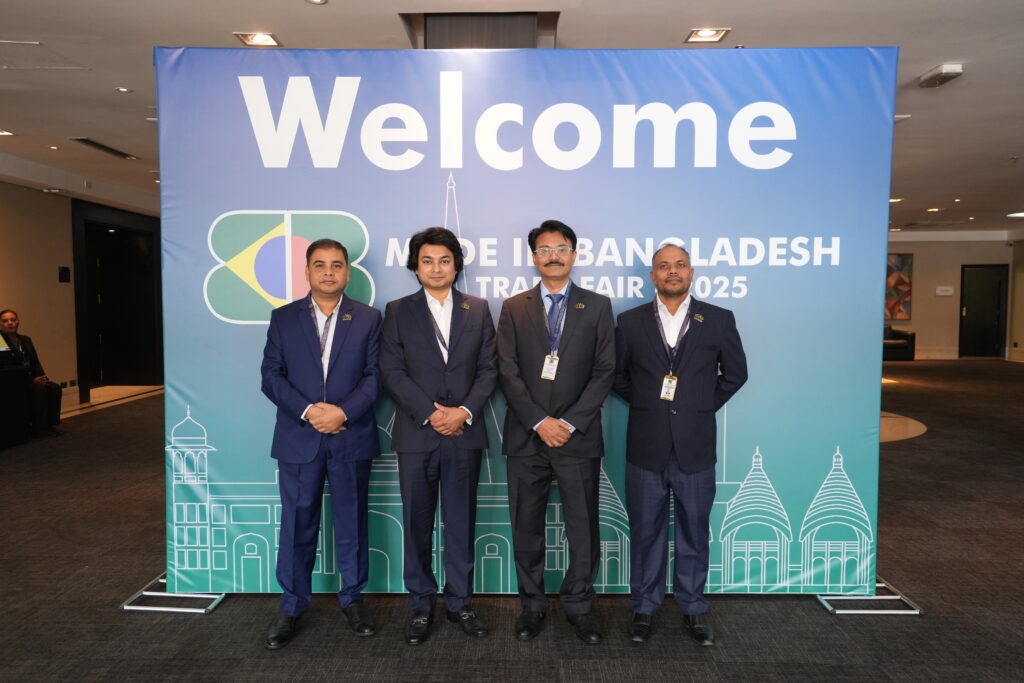
The Brazil Bangladesh Chamber of Commerce & Industry”,”bilateral chamber” positions itself as a bilateral platform for trade and investment facilitation with specific services: business matchmaking, market intelligence, trade promotion, investment facilitation, advisory, advocacy, and training/capacity building. [46] Its event track record (as published on its site) includes activities tied to “Made in Bangladesh Expo 2025” in São Paulo[47], framed by BBCCI as a market-diversification initiative with B2B matchmaking and follow-up collaboration narratives; the BBCCI-published post describes MoU and JV discussions as examples of outcomes, which investors should independently verify during due diligence. [48]
A practical “first move” for Brazilian investors is to use BBCCI as a bridge for partner discovery while running a parallel diligence track through Bangladesh’s core agencies: the national investment authority for facilitation, the company registrar for incorporation, the tax authority for registrations/incentives, zone authorities for land/utilities/customs facilitation, and PPP structures for infrastructure-linked investments. [49]
Due diligence checklist (screening-to-commitment):
- Validate demand with at least two independent channels (buyer contracts / distributor LOIs / competitive pricing benchmarks) and reconcile market-size claims across official and third-party sources. [50]
- Confirm incentive eligibility in writing (zone authority + tax authority basis), including whether incentives are governed by SRO references and whether policy stability clauses/grandfathering apply to your structure. [51]
- Run FX and repatriation planning early: model dividend/profit remittance documentation, timing, and regulatory circular applicability; build contingency for policy updates. [52]
- Perform land/lease diligence (boundary, title, encumbrances, utilities) and prefer EPZ/EZ leases for speed unless land strategy is a key moat. [53]
- Audit compliance readiness (labor, safety, environment) against buyer and regulator requirements; treat corruption risk as a compliance-system design input. [54]
- Stress-test logistics: port performance, inland transit times, and inventory buffers; use CPPI/LPI-type signals as hard constraints in your operating model. [55]
- If PPP-linked, confirm procurement route (solicited vs unsolicited), VGF applicability, and risk-sharing terms; enforce bankability standards in contracting. [56]
BBCCI contact details (as published on its official site):
– Address: Shanta Skymark, Levels 8–13, 18 Gulshan Avenue, Gulshan[57], Dhaka[58]-1212. [59]
– Email: president@brazilbangladeshchamber.com; vp@brazilbangladeshchamber.com; sg@brazilbangladeshchamber.com. [59]
– Website: brazilbangladeshchamber.com. [59]
[1] [6] [12] [47] [61] https://www.imf.org/en/news/articles/2026/01/30/pr-26029-bangladesh-imf-executive-board-concludes-2025-article-iv-consultation
[2] [43] https://www.tbsnews.net/economy/bangladeshs-export-brazil-26-fy25-1224566
https://www.tbsnews.net/economy/bangladeshs-export-brazil-26-fy25-1224566
[3] [51] [67] [69] https://bepza.gov.bd/public/storage/upload/brochure/251204054916-1764Investment%20Promotional%20Brochure%20%28English%20language%29%20%282%29.pdf
[4] [37] [39] [40] [41] [50] [70] BIDA | Top Investment Opportunities in Bangladesh
https://www.investbangladesh.gov.bd/opportunities
[5] [57] https://www.un.org/ldcportal/content/bangladesh-graduation-status
https://www.un.org/ldcportal/content/bangladesh-graduation-status
[7] https://bbs.gov.bd/pages/news/inflation-858-food-national-829-non-food-national-881-rural-inflation-863-urban-inflation-857-january-2026-69885b6fd42c19fb860b1697
[8] https://www.reuters.com/world/asia-pacific/bangladesh-receive-13-billion-imf-reform-deal-reached-2025-05-14/
[9] [10] https://objectstorage.ap-dcc-gazipur-1.oraclecloud15.com/n/axvjbnqprylg/b/V2Ministry/o/office-epb/2024/12/d3f3644b35b54cf3a7bbb419281da7f6.pdf
[11] [36] [42] [75] https://www.bgmea.com.bd/dailyTrades/2025-05-06
https://www.bgmea.com.bd/dailyTrades/2025-05-06
[13] https://bida.gov.bd/press-release/bangladeshs-net-fdi-jumps-over-200-in-q325
https://bida.gov.bd/press-release/bangladeshs-net-fdi-jumps-over-200-in-q325
[14] https://www.reuters.com/world/asia-pacific/main-issues-bangladeshs-february-12-election-2026-02-10/
https://www.reuters.com/world/asia-pacific/main-issues-bangladeshs-february-12-election-2026-02-10/
[15] [54] https://www.transparency.org/en/cpi/2025
https://www.transparency.org/en/cpi/2025
[16] https://legislativediv.portal.gov.bd/sites/default/files/files/legislativediv.portal.gov.bd/page/64379df1_f98c_47ff_b9e6_cbcabadd8ece/28.Bangladesh%20Investment%20Development%20Authority%20Act%2C%202016.pdf
[17] https://www.dhakachamber.com/storage/covid-19/oss.pdf
https://www.dhakachamber.com/storage/covid-19/oss.pdf
[18] https://www.tbsnews.net/economy/bangladesh-leaps-12-notches-world-banks-logistic-performance-index-621826
[19] [21] [55] https://documents1.worldbank.org/curated/en/099060324114539683/pdf/P17583313892300871be641a5ea7b90e0e6.pdf
[20] https://www.ficci.org.bd/ficci-stories/chattogram-port-bangladeshs-gateway-to-blue-economy-and-international-trade
[22] [38] https://www.bonikbarta.com/home/news_description/382270/50-mismatch-in-Bangladesh-Bank%E2%80%99s-own-figures-on-net-FDI
[23] https://english.news.cn/asiapacific/20260120/9c41a2ae73cf487e9cb95af8c7d04fb1/c.html
https://english.news.cn/asiapacific/20260120/9c41a2ae73cf487e9cb95af8c7d04fb1/c.html
[24] [65] https://www.reuters.com/world/asia-pacific/bangladesh-secures-20-us-tariff-garments-exporters-relieved-2025-08-01/
[25] https://bdlaws.minlaw.gov.bd/act-597.html
https://bdlaws.minlaw.gov.bd/act-597.html
[26] https://mincom.portal.gov.bd/sites/default/files/files/mincom.portal.gov.bd/law/b337bf56_d94e_4ef2_8d47_54af24539459/Company%20Act%2C%201994.pdf
[27] [35] [53] [62] [64] [76] https://www.bepza.gov.bd/public/storage/upload/brochure/240312053203-9424English%20Folder%20%281%29.pdf
[28] https://bepza.gov.bd/public/storage/upload/brochure/251026103523-3226BEPZA%20Economic%20Zone%20Brochure%202025.pdf
[29] https://ficci.org.bd/uploads/file/file_content_BEZA_Incentives_Packages_2020___1640748008.pdf
https://ficci.org.bd/uploads/file/file_content_BEZA_Incentives_Packages_2020___1640748008.pdf
[30] [78] https://www.pppo.gov.bd/download/ppp_office/PPP_Law_2015_%28Approved_Translation%29.pdf
https://www.pppo.gov.bd/download/ppp_office/PPP_Law_2015_%28Approved_Translation%29.pdf
[31] [56] [58] https://www.pppo.gov.bd/download/ppp_office/Rules-for-VGF-for-PPP-Projects-2018.pdf
https://www.pppo.gov.bd/download/ppp_office/Rules-for-VGF-for-PPP-Projects-2018.pdf
[32] https://www.pppo.gov.bd/download/ppp_office/Guidelines-for-Unsolicited-Proposals-2018.pdf
https://www.pppo.gov.bd/download/ppp_office/Guidelines-for-Unsolicited-Proposals-2018.pdf
[33] [52] BIDA FAQ | Answers to Investment, Visa, Tax & Business …
https://bida.gov.bd/faq?utm_source=chatgpt.com
[34] [72] https://lfmeab.org/wp-content/uploads/2025/10/sep302025fepd37e.pdf
https://lfmeab.org/wp-content/uploads/2025/10/sep302025fepd37e.pdf
[44] [77] https://www.risingbd.com/english/interview/news/110820
https://www.risingbd.com/english/interview/news/110820
[45] https://cottonbrazil.com/pdf/crop-report/Abrapa-Cotton-Brazil-Report-2025-11.pdf
https://cottonbrazil.com/pdf/crop-report/Abrapa-Cotton-Brazil-Report-2025-11.pdf
[46] https://brazilbangladeshchamber.com/our-services/
https://brazilbangladeshchamber.com/our-services/
[48] https://brazilbangladeshchamber.com/category/events/
https://brazilbangladeshchamber.com/category/events/
[49] [59] [60] https://brazilbangladeshchamber.com/contact-us/
https://brazilbangladeshchamber.com/contact-us/
[63] https://bida.gov.bd/publications/investment-handbooks
https://bida.gov.bd/publications/investment-handbooks
[66] https://bepza.gov.bd/pages/contact
https://bepza.gov.bd/pages/contact
[68] https://www.pppo.gov.bd/rti-focal-point.php
https://www.pppo.gov.bd/rti-focal-point.php
[71] https://mincom.gov.bd/pages/office-contents/69403117a31054345f0cb70d
https://mincom.gov.bd/pages/office-contents/69403117a31054345f0cb70d
[73] https://www.pppo.gov.bd/contacts.php
https://www.pppo.gov.bd/contacts.php
[74] https://www.pppo.gov.bd/ppp_incentives.php