

Bangladesh–Brazil Business Opportunities
Md. Joynal Abdin
Founder & Chief Executive Officer, Trade & Investment Bangladesh (T&IB)
Editor, T&IB Business Directory; Executive Director, Online Training Academy (OTA)
Secretary General, Brazil Bangladesh Chamber of Commerce & Industry (BBCCI)
Bangladesh and Brazil sit on two different ends of the globe, but their economies are naturally complementary. Brazil is a world-scale supplier of agricultural commodities, raw materials, and industrial inputs, while Bangladesh is a globally competitive manufacturer especially in textiles and apparel supported by a large, export-oriented private sector. Over the last decade, this complementarity has translated into growing commercial ties, deeper supplier relationships (notably in cotton for Bangladesh’s textile industry), and expanding opportunities for Bangladeshi importers and exporters to diversify markets, reduce single-country risk, and build long-term contracts with dependable counterparts.
Current Bangladesh–Brazil Trade (volume and product-wise)
Trade volume and direction
In practice, the trade balance is heavily tilted toward Brazil because Bangladesh imports large volumes of essential commodities and raw materials. Recent UN Comtrade-based estimates show Brazil’s exports to Bangladesh at about US$2.72 billion in 2025, while Brazil’s imports from Bangladesh were about US$281.79 million in 2025. On a month-to-month snapshot, Brazil exported US$368 million to Bangladesh and imported US$22.8 million from Bangladesh in December 2025, reflecting how consistently large Bangladesh’s import demand is from Brazil.
Bangladesh’s Export Promotion Bureau (EPB) figures also show Bangladesh’s exports to Brazil rising in recent fiscal years reported at US$187 million in FY 2024–25, up from US$147 million in FY 2023–24. (These fiscal-year figures and calendar-year Comtrade figures can differ because of reporting timing, valuation methods, and coverage, but together they confirm a clear upward trajectory.)
What Bangladesh mainly imports from Brazil?
Bangladesh’s import basket from Brazil is concentrated in a few big-ticket categories that directly support food security, livestock and poultry feed, edible oil supply, and the textile value chain. In 2025, major categories included sugars and sugar confectionery (~US$874.47M), cotton (~US$814.83M), cereals (~US$389.08M), animal fodder/residues (~US$215.58M), oil seeds/oleaginous fruits (~US$211.95M), and animal/vegetable fats and oils (~US$137.20M). A key structural development is Brazil’s growing role as a cotton supplier to Bangladesh; a USDA-referenced report highlighted that in MY 2024–25 Bangladesh imported 8.28 million bales of cotton and Brazil supplied about 1.9 million bales (about 23%), making it the largest supplier in that period.
What Bangladesh mainly exports to Brazil?
Bangladesh’s exports to Brazil are dominated by readymade garments (RMG) including knit and woven apparel along with smaller but promising flows of home textiles and select diversified items. EPB reporting highlights apparel such as jerseys, pullovers, shirts, suits, jackets, trousers and shorts as leading items.
Business opportunities for Bangladeshi importers (product-wise)
For Bangladeshi importers, Brazil is not just a spot-market origin; it can be a strategic, contract-based sourcing partner especially for industries where Bangladesh needs stable, high-volume supply.
Brazil remains highly competitive in raw cotton for spinning mills, especially where importers value steady shipment programs, consistent quality parameters, and long-term price competitiveness. The fact that Brazil has become a leading cotton supplier for Bangladesh in recent marketing-year data signals room for deeper mill-to-ginner/trader relationships, forward contracts, and supply-chain financing structures.
Brazil is also a major source of raw and refined sugar, and the scale reflected in 2025 category values indicates continuing opportunity for Bangladeshi refiners, food processors, and large commodity trading houses to negotiate term contracts, diversify shipment windows, and reduce supply disruption risk.
For the livestock, poultry, and fisheries ecosystem, Brazil-origin soybeans, oil seeds, and feed residues/animal fodder inputs are commercially significant. These inputs affect downstream costs across protein production and consumer food prices, so reliable sourcing relationships supported by proper quality inspection, documentation, and shipment scheduling can be a major competitive advantage for Bangladeshi importers.
On the food security side, Brazil-origin cereals are another category with material trade value in 2025, creating opportunity for Bangladesh’s grain traders and large importers to structure diversified sourcing portfolios.
Finally, for industrial importers, Brazil can supply select quantities of iron and steel, pulp/cellulosic materials, and niche industrial inputs that support Bangladesh’s manufacturing base, packaging, paper, and construction-linked supply chains.
Business opportunities for Bangladeshi exporters (product-wise)
For Bangladeshi exporters, Brazil represents a large consumer market with a diversified retail ecosystem and a sizable industrial base meaning opportunities exist both in mass-market and in value-focused niches.
The strongest, proven opportunity is still readymade garments (RMG). Brazil’s steady demand for apparel creates space for Bangladesh to expand beyond basic items into consistent programs for knit tops, denim, casualwear, uniforms/workwear, and season-appropriate product lines. EPB-linked reporting confirms apparel categories as the core of Bangladesh’s export basket to Brazil, and the FY export growth trend suggests the market is receptive when exporters invest in the right buyers and compliance pathways.
Beyond RMG, Bangladesh can grow exports of home textiles especially if exporters approach Brazil with hospitality-grade and retail-ready assortments, consistent sizing/labeling, and reliable repeat orders.
Bangladesh also has long-run potential in jute and eco-friendly packaging products, particularly as global buyers (including in Latin America) increasingly explore sustainable alternatives for bags, packaging, and lifestyle products. Brazil’s agribusiness and retail sectors can be relevant end-users for such items when exporters match product specifications, compliance needs, and price points.
There is also niche opportunity for footwear and leather goods and selected light engineering/plastic products, but these segments typically require careful buyer selection, differentiation, and attention to tariffs, standards, and local competition so exporters benefit most when they pursue focused product niches instead of trying to compete broadly across all categories at once.
How to explore these business opportunities (a practical pathway)?
Success in Bangladesh–Brazil trade usually comes from treating market entry as a structured process rather than a one-off shipment. It begins with choosing the right HS/NCM classification and building a landed-cost view that includes tariffs, internal taxes, logistics, insurance, banking costs, and any product-specific certification requirements. Once pricing and compliance feasibility are confirmed, the next step is partner discovery: identifying credible Brazilian importers/agents (for exporters) or credible Brazilian producers/traders (for importers), verifying their trade history, and shortlisting partners who can handle the scale and documentation discipline that cross-continental trade demands.
Because Brazil is far from Bangladesh, logistics planning matters more than usual. Importers should negotiate shipment windows, partial shipments, and contingency clauses; exporters should ensure production planning aligns with shipping schedules and that documentation is “clean” to avoid delays. Payment-risk management is equally important; letters of credit, reputable trade insurance options, and bank-to-bank confirmation practices are common tools to reduce risk on both sides.
Finally, relationship-building accelerates results. Targeted B2B meetings, participation in trade fairs, and structured trade missions often convert faster than cold outreach—especially when supported by a bilateral chamber that can introduce credible counterparts and reduce trust barriers.
Role of Brazil Bangladesh Chamber of Commerce & Industry (BBCCI)
BBCCI functions as a bilateral trade bridge helping Bangladeshi importers and exporters move from “interest” to “execution.” In practical terms, BBCCI can support trade promotion through business networking, coordination of B2B meetings, trade delegation facilitation, institutional communication with relevant stakeholders, and advisory guidance on market-entry steps. For Bangladeshi businesses, this type of chamber-backed pathway is useful because Brazil is a relationship-driven market where trusted introductions, verification, and continuity often matter as much as pricing.
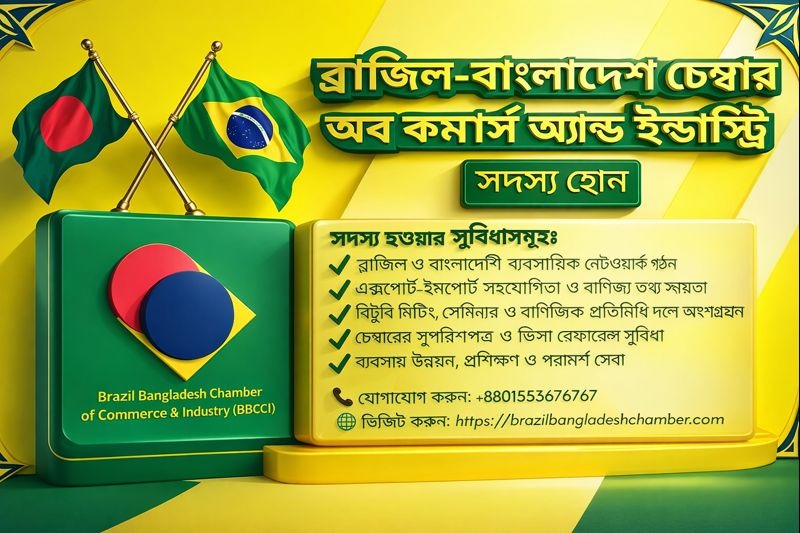
Become a member of BBCCI
BBCCI membership is designed for companies and professionals who want consistent access to the Bangladesh–Brazil business network. As a member, a business typically benefits from structured networking, priority information flow on relevant opportunities, and greater visibility inside chamber activities and B2B engagement efforts. The usual membership journey involves submitting a membership application with basic business credentials and contact details, completing membership formalities, and then actively participating in BBCCI’s programs so that the chamber can match the member with relevant Brazilian or Bangladeshi counterparts based on sector and trade interest.
Contact details of BBCCI
Brazil Bangladesh Chamber of Commerce & Industry (BBCCI)
Phone: +880 1553 676767
Email: sg@brazilbangladeshchamber.com
Website: www.brazilbangladeshchamber.com
Office Address: Shanta Skymark, Level 12, 18 Gulshan Avenue, Dhaka-1212, Bangladesh
Closing remarks
Bangladesh–Brazil trade is already substantial in critical commodities and is steadily expanding in Bangladeshi exports especially apparel. The next wave of opportunity will come from deeper, more professional engagement: long-term sourcing programs for importers, strategic buyer development for exporters, stronger compliance and documentation discipline, and relationship-led market entry supported by institutions like BBCCI. For Bangladeshi businesses that want to diversify supply and sales beyond traditional corridors, Brazil is not a “future market” it is a present market, and the companies that move systematically now will be the ones best positioned to lead this corridor in the years ahead.